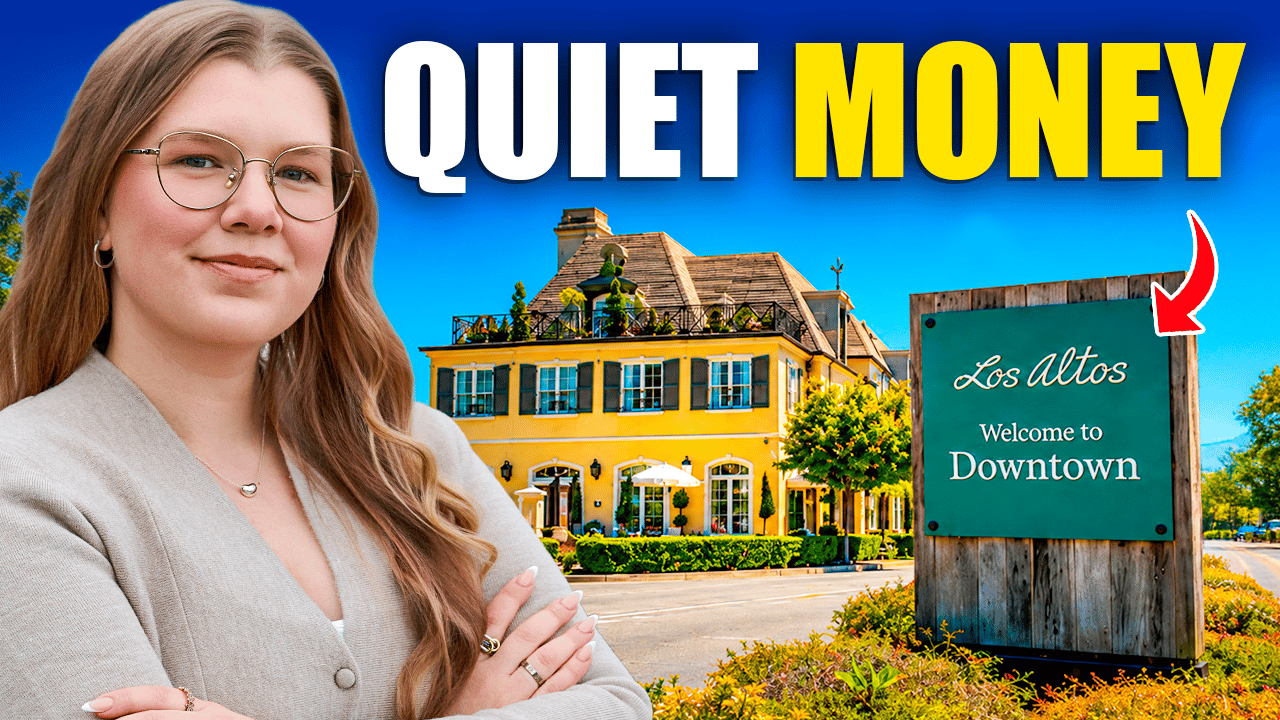
Inside Los Altos: Silicon Valley's Most Exclusive Town
Drive through Los Altos and you might not even realize you've passed through one of Silicon Valley's most expensive ZIP codes. There are no famous gates, no tech campus banners — just tree-lined streets, single-story ranch homes, and a downtown that looks frozen in time.
Then you see the price tags.
The median Los Altos home is going for around $4.3 million. Homes go pending in about 10 days. And roughly 70% of homes sell above asking. This is what quiet money looks like — wealth that doesn't announce itself.
In this guide, we'll walk through what that price actually buys, why an "invisible line" a few blocks wide can swing a home's value by hundreds of thousands of dollars, what daily life here really feels like, and how to know if Los Altos is actually the right fit for you — not just the right ZIP code.
The Quiet Money Phenomenon
Los Altos is a mostly residential city of about 7 square miles, dotted with a few small shopping districts. There's no flashy signaling here — just decades-old zoning choices that kept the city small, and a buyer pool willing to pay handsomely for that scarcity.
Here's what the numbers look like right now:
- Typical home value: around $4.3 million
- Appreciation: roughly 1.8% annually
- Median days to pending: about 10 days
- Homes selling above asking: around 70%
To put that $4.3 million in perspective: a 20% down payment alone is roughly $860,000, and lenders will typically want to see an income well north of $775,000 a year to qualify. Even then, you're likely competing with three or four other offers on any home you actually like.
Interestingly, the typical Los Altos household earns just over $250,000 a year — well short of what the math above requires. That gap tells you something important: income alone doesn't get most buyers in the door. It's usually a combination of income plus real accumulated capital — proceeds from a liquidity event, equity from a prior home sale, or years of saved capital — that makes a Los Altos purchase possible.
What $4 Million-Plus Actually Buys You
First-time visitors to Los Altos often say the same thing: the houses look smaller than expected. Then they see the lot — and the conversation changes.
Los Altos doesn't have an official "best neighborhoods" list. Instead, it's a series of residential pockets clustered around small commercial nodes — Downtown Los Altos, Loyola Corners, the Rancho Shopping Center, and retail stretches along Foothill Expressway and El Camino Real. The surrounding neighborhoods share a common feel: bigger lots, lower density, and mature trees that took decades to grow.
In practice, your money is typically buying one of two things: a single-story ranch home on a generous lot (often already remodeled, or ready for a rebuild), or a teardown positioned for a modern estate. Either way, you're not buying square footage for its own sake — you're buying land, privacy, and the kind of spacing between homes that newer developments simply can't replicate.
But the lot is only the second most important thing you're paying for. The first thing is something you can't see from the street — and it's the real engine behind this entire market.
The Education Engine (and the Invisible Line That Moves Prices)
One of the most common — and expensive — mistakes buyers make in Los Altos is assuming a Los Altos address guarantees a specific school assignment. It doesn't.
The city is served by multiple districts. For grades K–8, homes fall under either the Los Altos School District or the Cupertino Union School District, depending on the exact address. For high school, it's either Mountain View Los Altos Union High School District or Fremont Union High School District. Your specific street address — not your ZIP code, and not the neighborhood name your agent uses — determines which schools your kids attend.
The Los Altos School District runs 9 K–8 campuses (7 elementary, 2 middle schools), where students typically score in the 80–85% range on California state math and reading assessments. Cupertino Union performs similarly, often above 80%. For context, the statewide proficiency average sits closer to 35–40%.
That gap is exactly why two nearly identical homes on the same block — same era, similar size, similar lot — can carry price tags that differ by hundreds of thousands of dollars, simply because one falls inside a stronger school boundary and the other doesn't. Across the wider Peninsula, in areas with bigger score disparities, that gap can stretch past $2 million between comparable homes.
This is why school verification has to happen before you write an offer, not after you close. Pull district maps directly from the city or county, and confirm the assigned school with the district office in writing. Buyers who skip this step sometimes don't discover the mismatch until school registration — long after it's too late to do anything about it.
A Day in the Village
Beyond the price tag and the school boundaries, it's worth understanding what daily life in Los Altos actually feels like.
Downtown Los Altos is the heart of the city, home to more than 150 shops and businesses according to the Los Altos Village Association. The city and local groups host farmers' markets and seasonal street-closure events throughout the year, along with the Los Altos Arts and Wine Festival each July along Main and State Streets.
For entertainment, the Los Altos Stage Company performs a full season at the intimate Bus Barn Theater (under 100 seats). History buffs can visit the free Los Altos History Museum on South San Antonio Road, which traces the area's path from orchard town to Silicon Valley enclave. The city's Parks and Recreation Department maintains around 11 parks, plus the six-acre Redwood Grove Nature Preserve along Adobe Creek.
What you won't find is much of a nightlife scene — no late-night clubs, no bar-hopping strip. A Saturday night here looks like a show at Bus Barn or dinner downtown, followed by an early night at home. That's the honest trade-off: buzz for calm, walkable nightlife for walkable parks. For the right buyer, it's close to paradise. For anyone hoping for more energy after dark, it's worth sitting with before you commit.
The 2026 Market Reality
Los Altos remains a squeezed market. At roughly 7 square miles and largely built out, the city can't meaningfully expand its housing stock. Combine that fixed supply with strong schools, single-family-only zoning, and a well-capitalized buyer pool, and you get a market defined by high prices and fast-moving inventory.
Current conditions:
- Typical home value around $4.3 million, with some quarters seeing median sale prices cross $5 million
- Prices continuing to rise year-over-year
- Median days on market around 10 — often just one weekend of open houses before an offer deadline
- About 70% of recent sales closing above asking
- Only a few dozen homes on the market at any given time, with new listings absorbed within weeks
In this kind of market, being "interested" isn't enough — buyers need to be decision-ready, with an inspection plan, loan pre-approval, and a clear number in mind before they tour.
On commute access: Los Altos doesn't have its own Caltrain station, but Mountain View's stations are a short drive away, and both the 101 and 280 are close by. Apple Park is roughly 15–20 minutes away, Google's Mountain View campus about 10 minutes, and Meta's Menlo Park campus 20–25 minutes depending on traffic — giving residents strong connectivity without a freeway running through the neighborhood.
The Number That Explains This Market
If there's one statistic that explains Los Altos better than any other, it's this: over 70% of homes close above asking. That number means there's effectively no room to negotiate. When a home you want hits the market, the real question isn't whether to make a low offer — it's whether to compete at all.
Once buyers accept that they're competing rather than negotiating, everything else changes: loan terms, offer structure, timeline, and emotional readiness.
Looking back across dozens of Los Altos transactions, a pattern emerges: the happiest buyers are rarely the ones who walked in laser-focused on Los Altos by name. Most buyers arrive chasing a well-known ZIP code — and then, once they see the town firsthand, something shifts. What they actually want, once the "famous name" is stripped away, is a quieter daily life: strong schools, a walkable downtown, and privacy without any flash. That desire is what drives the willingness to pay above asking and move fast.
Los Altos is the right answer for fewer buyers than its reputation suggests — but for the right buyer, it's an easy yes. The mistake is treating it as a flex purchase, when it's really a lifestyle purchase that happens to carry a flex price tag.
Is Los Altos Right for You? A 3-Part Test
Ask yourself honestly:
- Do you actually like quiet — quiet on a Saturday night, with no walkable bar scene?
- Are excellent schools worth a six-figure price premium to you, even if you don't have kids, given the resale value they add?
- Do you have real accumulated cash, not just a strong income, to compete in a market where most homes sell above asking?
Three yeses, and Los Altos is likely your town. Two yeses, and it may be worth also looking at areas like Mountain View's Cuesta Park or parts of West Sunnyvale. One yes or fewer, and this probably isn't the right fit — and that's a perfectly fine answer.
The real mistake in Los Altos isn't choosing wrong. It's finding out six months after closing.
If you're weighing Los Altos against another Peninsula town and want help figuring out whether it actually fits your situation, reach out — even a short conversation can bring real clarity before a decision this size. Contact me today to chat Los Altos Real Estate!